
Comprehensive Analysis on Behavior Trees (BT) and Finite State Machines (FSM)
Decision-making mechanisms, which form the foundation of autonomous agents, complex video game characters, and industrial robotic systems, constitute one of the most critical and heavily debated areas of modern software engineering and artificial intelligence research. How an agent will react to constantly changing environmental stimuli, which of the countless targets at hand it will prioritize, and in what order it will execute specific tasks entirely depend on the robustness and flexibility of the decision-making architecture upon which it is based. Examining the historical development process, it is seen that this field was dominated for many years by Finite State Machines (FSM). However, the increasing complexity of digital worlds and physical robotic tasks has driven developers and researchers to seek more scalable, reactive, and modular structures, and this quest has paved the way for the birth of revolutionary hierarchical structures such as Behavior Trees (BT).
This report examines these two fundamental architectures, which are accepted as industry standards today for decision-making and behavior modeling in autonomous systems, in depth regarding all their technical details, mathematical infrastructures, historical evolutions, industrial use cases, and structural advantages and disadvantages against each other. Additionally, the latest hybrid approaches in modern game motors (such as Unreal Engine) and next-generation solutions like State Trees are evaluated as an integral part of this analysis.
Finite State Machines (FSM): Theoretical Infrastructure and Mathematical Foundations
A Finite State Machine (FSM) is an abstract machine model in which a system can only be in a single predefined state at any given time and makes transitions between states in response to specific environmental inputs or internal events (inputs/events). As one of the most fundamental building blocks of computation theory, this model is used in a wide range of computer sciences, from algorithm design to the construction of digital electronic circuits.
FSMs can theoretically be designed by separating them into two main categories: deterministic or non-deterministic. However, one of the fundamental theorems of computation theory proves that for any non-deterministic finite state machine, an equivalent deterministic finite state machine that recognizes the exact same language and produces the same behavioral outputs can always be constructed. This theorem allows software engineers to reduce complex scenarios to more predictable deterministic structures.
Logical Representation and State Transition Dynamics

Finite State Machines are essentially visualized and expressed as a directed graph or a state diagram. In this directed graph, nodes represent the internal states of the abstract machine, and directed arrows (edges) connecting these nodes represent state transitions. The current state of the system at any time "t" is always calculated as a deterministic function of the previous state and the current inputs entering the system at that moment.
In a mathematical context, this state transition function is expressed as follows:
In this formulation, represents the next state of the system, the previous (current) state of the machine, the current input value, and the state transition function. This relation is frequently shown in the literature as the operation of mapping the Cartesian product of the state set (S) and the input set (I) back to the state set, namely as . State machines are also divided into two main architectural subclasses based on the nature of the outputs they produce: while the output function depends solely on the current state of the system in the Moore Machine model (), the output function depends simultaneously on both the current state and the instantaneous input in the Mealy Machine model ().
In system design, states and inputs are typically represented by a binary alphabet or predefined enumerations (enums), and the and functions are generally coded in the form of a look-up table or state transition table. In software architecture, the realization of transitions depends not only on the presence of inputs but also on the fulfillment of additional conditions (guards). In a typical UML state diagram or modern engine implementations, the notation of a transition is usually expressed with the trigger[guard]/effect syntax. Here, the trigger can be a signal, call, timing, or change event. The guard is an extra logical test that must be verified for the transition to occur. The effect is the specific operation executed during the transition.
However, the power of the FSM architecture lies not only in transitions between states, but also in actions that can be executed when entering certain states, remaining within those states, and exiting those states. When entering an FSM state (entry action), periodically while inside the state (during action), and when exiting the state (exit action), special code blocks can be executed. For example, in a radio system, pressing the "Forward" button while the device is in the "Radio" state provides a transition to the next radio station, whereas pressing the same "Forward" button while the device is in the "CD" state triggers a transition to the next song track; thus, the exact same environmental stimulus produces completely different actions depending on the contextual state the machine is in.
The Place of FSM in Industry Standards and Practical Advantages
Finite State Machines have maintained their existence as an industry standard across a wide historical background extending from digital circuit design to the gaming industry. Their most prominent advantages are that they are extremely easy to understand conceptually, have architectural simplicity, and offer tremendous operating speeds at the hardware/software level. A designer visualizing what a character or system can do and what states it can transition into via a "box and arrow" diagram makes FSMs an extremely intuitive and easy-to-debug structure during the coding process.
Particularly in areas where it is critical to determine a system's instantaneous mode, animation phase, or physical state with precise, impenetrable boundaries, FSMs are unrivaled. The specific contexts where FSMs operate flawlessly are as follows:
First, fighting games are one of the brightest application areas of the FSM architecture. In a fighting game, a character's "Attack", "Jump", "Stunned", "Crouch", or "Defense" states must be separated from each other by precise, logical lines. For example, when a character takes a heavy blow from an opponent and enters the "Stunned" state, the character cannot jump even if the player presses the jump button. If the FSM architecture is not used, it becomes necessary to write nested conditional statements that stretch out and become unmaintainable with every action attempt of the character, in the form of "if the character is not stunned and if not in the air and if not locked in an attack animation...". FSMs prevent this massive spaghetti complexity in code blocks by perfectly executing the logic that "if the character is in state A, they can only transition to state B or C".
Second, character animation controllers are largely FSM-based. In modern game engines like the industry leader Unreal Engine, character animations are controlled by interfaces called "Animation Blueprints" that run a state machine in the background. When and how a character transitions from an "Idle" animation to a "Walk" animation, and from there to a "Run" animation, is the core function of FSMs managed with this box-and-arrow interface.
Third, in arcade systems and games requiring simple decision logic, FSMs are ideal for operating with the "KISS" (Keep It Simple, Stupid) principle. In many arcade-style games, enemies have very limited and specific states such as "Patrol", "Chase", "Attack", or "Flee". An FSM implemented in a native C++ environment operates at the nanosecond level on modern processors, offering unique performance. Software developers can define states using unnamed enums and bind these states to event IDs using a "one big switch" structure or bit-masking techniques. The orderly code architecture brought by this structure allows the FSM to be hot-recompiled at runtime while providing execution safety by returning non-zero state statuses from event handlers instead of subroutines like SetState(). This linear execution flow makes it possible to achieve high framerates by preventing any stutter in the game loop.
Architectural Crisis Point: The State Explosion Problem
Although FSMs are flawless and performant for deterministic behavior models with a limited number of states, they tend to structurally collapse as the complexity of the autonomous system, the number of environmental variables, and the behavioral repertoire expected of the AI increase. This chronic vulnerability is called "State Explosion" in the literature.
The fundamental constraint of the FSM architecture is that the machine can only be in a single state at any given time. If a character is to run and shoot at the same time, in the FSM architecture the character cannot be in the "Running" and "Shooting" states simultaneously; instead, a brand-new hybrid state called "Run and Shoot" must be created. Every new variable added to the system requires the generation of as many new states as their possible combinations with all existing states. The number of states the model needs to represent reaches massive dimensions, equivalent to the Cartesian product of the variable sets.
An even more critical problem is the transition complexity created by the increasing number of states. Adding a state in an FSM does not just mean creating that state; it requires coding one by one, with specific rules, how to transition to this newly added state from all other relevant states in the system and which states can be returned to from this state. In computer science jargon, the growth rate of transition complexity with an increasing number of states is expressed as quadratically proportional. This geometric growth rate creates a cumulative load of complexity similar to Metcalfe's Law, which argues that the value of a telecommunications network is proportional to the square of the number of users in network economics.
When an FSM reaches approximately 10 states, it becomes difficult to manage; when the number of states reaches 40 (for example, in an advanced Sekiro or Dark Souls style boss fight AI), the code file fills with hundreds of
lines of transition logic and literally transforms into "Spaghettification". 13 At this stage, maintaining the code or debugging evolves into a nightmare. This is because the root cause of any logical bug that emerges can be a faulty trigger in one of dozens of different state transitions, a wrongly structured priority order, or a forgotten transition arrow. 23
"Hierarchical Finite State Machines" (HFSM) have been developed to mitigate this state explosion and somewhat prevent the formation of spaghetti code. In the HFSM model, states are designed to be nested; a "parent state" houses independently operating "substates" within itself. For example, a main state called "Combat" can have a sub-machine running "Take Cover", "Aim", and "Shoot" substates within it. If the system is in the "Combat" main state and the player moves away, a single "Group Transition" from the main state to the "Patrol" state, regardless of which substate is currently active, eliminates the need to write escape or cancellation code for each of the inner substates one by one. 8 Thanks to transition points and event triggering precedence, HFSMs push the capacity of FSMs a bit further. 24 However, when system complexity exceeds a certain threshold (for example, a complex task scheduler containing dozens of states and hundreds of transitions), even HFSMs yield to visual complexity and become structurally fragile. 8
Behavior Trees: Evolution, Structure, and Execution Logic

The geometric scalability barrier introduced by FSMs and HFSMs has made the birth of a brand-new architectural paradigm mandatory in the decision-making processes of autonomous characters and agents. Behavior Trees (BTs) are modular, hierarchical decision-making structures developed precisely to overcome this bottleneck and provide artificial intelligence with a visual and clear roadmap without getting lost in rigid transition labyrinths of the "if this happens, then do that" style. 2
Historical Origins and Industrial Adoption Process
Although academic and industrial accounts regarding exactly when and where behavior trees emerged show some minor differences, it is widely accepted that these structures came from the trenches of game development studios themselves rather than from sophisticated research laboratories. 2 One of the earliest documented uses dates back to the 1996 game SimCopter, developed by Maxis. According to statements by former Maxis employee Don Hopkins, a visual language called "SimAntics" was used to control NPCs within the game, which appeared in the people.df file in the game code as "reaction trees". Comment lines in this file contain definitions resembling modern behavior tree mechanics, such as "a reaction tree can be called by another reaction tree but cannot be interrupted at that moment". 25
However, the formulation of the Behavior Tree architecture in the modern sense, its transformation into an industrial standard, and its acquisition of a solid academic foundation largely took place with Damian Isla's iconic 2005 Game Developers Conference (GDC) talk ("Handling Complexity in the Halo 2 AI"), where he presented the revolutionary AI architecture of the game Halo 2. 3 During the Halo 2 development process, the Bungie team encountered two major deadlocks brought by FSMs: the system losing scalability against rapidly increasing behavioral diversity, and instability caused by the AI rapidly switching back and forth between decisions, namely the "dithering" problem. 3
Wanting to solve this mental overload (mental bandwidth) caused by FSMs, the team placed character behaviors into a hierarchy called "Behavior DAGs" (Directed Acyclic Graphs). 3 This system housed approximately 50 different core behaviors.
In the structure defined by Isla, the nodes at the top of the tree were responsible for decision-making algorithms, while the leaf nodes at the very end were responsible for executing actions. This approach ensured not only that the AI knew what to do, but also that it behaved with common sense. Furthermore, characters had their own internal "target lists" and spatial awareness (firing positions) to perceive goals. 3 This modular structure was so flexible, fault-tolerant, and readable that the concept quickly jumped to the field of robotics and academia. Today, Behavior Trees have become the de facto standard across a wide range, from unmanned aerial vehicles to industrial collaborative robots and autonomous driving systems. 1
Structural Architecture and Node Hierarchy of BTs
Behavior trees are a hierarchical tree data structure that connects actions and decisions together like digital LEGO blocks. 2 Unlike classical Decision Trees, BTs do not just follow a path until they reach a result; they manage the logical control of nodes, asynchronous execution flows, and interrupts through regular signals sent from the root of the system to its leaves (usually called a "tick"). 1
The most vital and distinguishing concept in the functioning of this architecture is that every node necessarily returns a logical status to its parent node as a result of a "tick" operation coming into it. These return statuses consist of three universal types:
Success: The node has fully and smoothly completed its task, or the tested condition is true.
Failure: The node has failed to perform its task, hit an obstacle, or the tested condition is false.
Running: The operation is not yet complete; multiple time cycles (ticks/frames) are required for the action to finish. 8
It is precisely the existence of this "Running" status that is a technological leap separating Behavior Trees from all other classical tree structures. 27 A physical robot cannot be expected to finish the command "Walk to Target" in a fraction of a second, nor can a game character be expected to instantly complete the "Open Chest" animation. The Running status allows that specific branch of the action to continue asynchronously in the background while preventing the system from blocking and freezing the execution thread. 27
Behavior trees structurally consist of three main node categories: Composites, Decorators, and Leaves. 28
1. Composite Nodes
Composite nodes are the branch-split points of the tree. They are building blocks that have multiple child nodes and decide in what order, under what condition, or simultaneously these child nodes connected to them will be executed. 28
Selectors (Selector / Fallback Nodes): It is a reflection of the OR operator in basic programming logic. It runs the child nodes connected to it in order from left to right. If one of the child nodes returns Success or Running, the Selector node instantly stops testing other children and passes this status up to its parent node. The only way for a Selector node to return Failure is if all child nodes connected to it fail. This structure is perfect for determining an agent's survival priorities or fallback plans: The system first tries the "Heal Self" option, if that fails it moves to the "Take Cover" option, and if that also fails it tries the "Flee" option. As soon as one succeeds, the action chain is satisfied. 8
Sequence Nodes: It is the behavior tree equivalent of the AND operator in basic programming. It tries child nodes from left to right. However, unlike Selectors, if one of the child nodes returns Failure, Sequences instantly cut the operation short and return Failure to the parent node. For a Sequence to return Success, it is mandatory that all child nodes it contains succeed without exception. This node is used to establish the logical step chain of a task: The chain required for an NPC to pass through a door is formulated as "Walk to Door", then "Unlock", then "Pull Handle", then "Enter Inside". If the door is locked and the character cannot pick the lock (Failure), there is no logic in moving to the subsequent steps; the sequence fails, and the character abandons the plan to pass through the door. 8
Parallel Nodes: It is one of the most complex members of the Composite family. It runs its child nodes not sequentially from left to right, but at the same time (simultaneously). It returns a result to the tree based on a specific success or failure policy (for example, "finish the operation when any of the child nodes succeed" or "wait until all of them succeed"). It is used for controlling simultaneous tasks, such as "a character gesturing with their hands while talking" or a robotic vehicle "advancing toward a target while performing a radar scan". 30
2. Decorator Nodes
Just like the Decorator pattern in design patterns, these are nodes that can have only a single child node and either modify the result returned by that child node according to various policies or condition its execution. 8
Inverter: It is the NOT operator in classical programming. It converts the Success result of the child node into Failure, and the Failure result into Success.
Limiter: It allows the child node to run only a specified number of times in a given second or throughout its entire life cycle; it returns a failure in cases exceeding this quota.
Timer: It delays the execution of the child node's action by a specified duration instead of running it immediately. 8
3. Leaf Nodes
These are execution nodes located at the very top, bottom-most level of the tree and, by nature, cannot possess any child nodes. 29 Leaves are the endpoints where direct interaction with the virtual game world or real robot sensors occurs, creating tangible effects in the system. 22
Actions / Tasks: These are the actual code blocks that create a physical or logical change in the world, play animations, produce sounds, or send power to motors ("Shoot", "Walk to Target", "Stop Motors").
Conditions / Queries: These are logical instant checks and sensor queries that usually return Success or Failure and do not perform any action ("Is the Enemy in Sight Range?", "Do I Have Ammo Left?", "Is the Battery Level Below 20%?"). 8
Event-Driven Behavior Trees and Observers
Early classical BTs worked with a polling logic that continuously re-evaluated the tree downwards starting from the root on every "tick" operation (usually every visual frame). 19 Although this was flawless in terms of reactivity, it created a massive central processing unit (CPU) overhead in the calculation of each frame. As a tree became very deep, the cost of repeatedly testing all conditions from top to bottom in every frame became unsustainable. 9
Modern game engines and industry standards like Unreal Engine have evolved the architecture into the "Event-Driven Behavior Trees" model to overcome this hardware bottleneck. 32 In this innovative structure, instead of policing conditions from start to finish on every "tick", the system uses reactive decorators called "Observer Aborts". For example, if a cat AI is chasing a mouse, a classical parallel node asks every second whether the mouse has entered the hole. In the event-driven structure, the condition "Is Mouse Observable" is placed in the tree as an Observer. As soon as the mouse escapes into the hole (event), this event is triggered, and the Observer instantly aborts the cat's current "Run" and "Jump" sequence. Thanks to this, the artificial intelligence recalculates only when its status actually changes, massive processing power savings are achieved, concurrent execution paths in complex trees are minimized, and system optimization is made incredibly easy. Furthermore, in the Unreal Engine system, special nodes called "Services" can be added to Composite nodes. Services run at specific periods (for example, every 2 seconds) as long as the sub-tree is active, replacing the periodic "during" actions of FSMs and continuously updating data such as enemy tracking.
The Memory Problem and the Blackboard Mechanism
The tremendous modularity of Behavior Trees comes with a price: BT nodes are completely isolated and stateless by design. In other words, a "Walk to Target" action node is unaware of what the "Find Enemy" condition node immediately to its left found or what decisions were made in previous cycles. Unlike FSMs, BTs do not save past decisions or instant sensor data into their own internal structures.
To fill this vital communication gap and provide the tree with a sort of "short-term memory", the Blackboard design pattern is used. The Blackboard is an external and shared data pool (usually structured as a Dictionary, Hash Map, or Variant data structure in programming languages) that all nodes in the tree can read from and write to during operation.
The operation works as follows: When a tree reaches the "See Enemy" condition node, this node detects the enemy's coordinates but does not hold this information itself; it directly writes it onto the Blackboard as TargetPosition = . When the tree flow reaches the next step, the "Go There" action node, the action node connects to the Blackboard, reads the TargetPosition data, and plots its route.
The Blackboard architecture builds an incredibly powerful, flexible, and fast data bridge between nodes and branches without compromising the pure modularity and node isolation of Behavior Trees.
Comparative Analysis: The Clash of FSMs and Behavior Trees
For architects preparing to lay the foundation of an artificial intelligence system from scratch, the choice between Finite State Machines (FSMs) and Behavior Trees (BTs) is not merely a preference of syntax or engine, but a vital architectural decision that will deeply affect the entire lifecycle of the project. Game Developers Conference (GDC) proceedings, industrial case studies, and academic robotics simulations published in recent years comprehensively compare the structural performances of these two systems in terms of Decision-Making, Modularity, Reactivity, Readability, and Scalability.
1. Decision-Making vs. State Control
The strongest consensus in the software industry is that BTs specialize in "Decision-Making" processes, while FSMs specialize in "State Control" processes.
Behavior trees are specifically optimized for making cognitive decisions ("What should the agent do now?") that are dynamic, respond to constantly changing environmental conditions, contain numerous logical branches, and require prioritization. FSMs, on the other hand, are tailor-made for the execution method of an already made decision, the management of consistent and isolated physical modes of the system, and the precise boundary control of sequential flows ("How and through which stages should the agent execute this action?").
The table below systematically summarizes these fundamental philosophical differences:
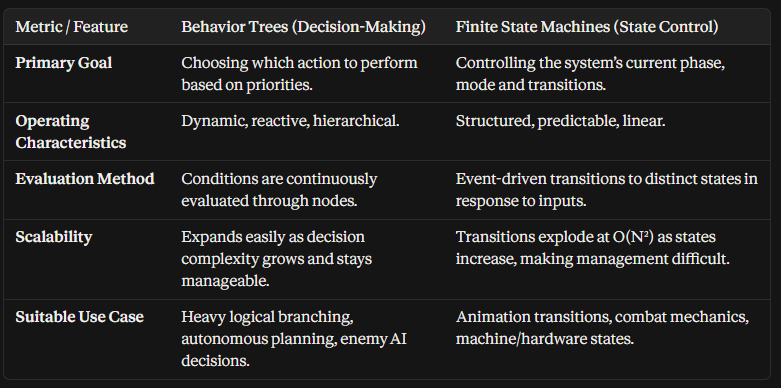
2. Modularity and the Coupling Crisis
BTs are, as accepted in the industry, low-dependency architectures. A BT leaf node (for example, the "Run Toward Target" action) is a self-contained, encapsulated object completely independent of where it stands in the tree. This node can be copied and dragged into a completely different branch named "Heavy Machine Gun Defense Mode" and work seamlessly without changing any source code.
In contrast, a "state" in FSMs must define within itself or its manager which specific states can be transitioned to next and under what conditions this transition will take place. This "tight coupling" approach makes it nearly impossible to copy a written code block from the project and transfer it to another AI. Every minor modification made in an FSM or the addition of a new state requires every single entry and exit arrow (transition) connected to that state to be recalibrated one by one. It has been statistically proven that adding new fault-tolerance behaviors (such as returning to autonomous charging when the battery runs out) to FSM-based systems in a robotic control study is times more difficult compared to BT systems.
3. The Clash of Expressiveness and Reactivity
Laboratory comparisons made in robotic control architectures reveal the philosophical difference inherent in these two architectures with striking metrics.
Expressiveness: Contrary to expectations, academic studies have proven that FSMs are more "expressive" than BTs. The active state in which an FSM resides is a tangible physical accumulation of decisions made in the past. If an FSM signals "I Am Currently in Alarm State," this information inherently contains the fact that a threat was detected in the past, the system validated this threat, and initiated a sequence of actions. BTs, on the other hand, are completely forgetful. In every new "tick" cycle, the tree starts scanning from the root node as if the world were newly created. It is entirely dependent on external data on the Blackboard to remember past actions or modes.
Reactivity: As the price of modularity, reactivity is weak in FSMs. Unless the FSM designer draws a transition arrow such as "If the robot suddenly hears a fire alarm while carrying an item, transition to this state," the robot will never drop the box in its hand and run away. BTs, however, are vastly more reactive than FSMs. Because the world is checked from scratch in each cycle or because Observers are used, the slightest environmental change allows the tree to immediately orient towards the highest priority branch (such as "Emergency Escape") and preempt the item-carrying action currently in the "Running" state.
4. Setup Cost, Debugging, and Maintenance

In decision-making systems, maintenance cost is the area where developers spend the most time. FSMs can be built from scratch in minutes at the initial stage with a very low cost, using just a few simple enums and switch-case statements. However, as the system grows over time, this advantage evaporates and debugging turns into absolute chaos.
Behavior trees, on the other hand, start with a heavy "boilerplate" load right from the beginning. Root mechanisms, Tick systems, Blackboard integration—just getting the system up and running is a serious architectural investment. However, once this price is paid, the real-time visual debugging capabilities they provide are tremendous. In systems such as the built-in BT tools inside Unreal Engine or the Beehave plugin developed for Godot, developers can monitor data flows on top of the tree (glowing green, red statuses) in real time while the game is played or the simulation is running, and identify why an action node failed within seconds. Finding the source of an error visually in FSM-based "spider webs," however, often takes hours.
Advanced Hybrid Architecture Applications and Goal-Oriented Systems
Getting stuck in just a single architectural pattern frequently causes failure in autonomous system projects. While a pure FSM approach hits a scalability wall, trying to design even the smallest movement loop or jumping algorithm using BT creates an unnecessary condition check by increasing the number of "Observers" and a massive CPU cost. Therefore, the "Gold Standard" in modern AAA games and industrial robotics solutions are hybrid designs where these two architectures are cleverly integrated to cover each other's weaknesses.
Behavior Tree and State Machine Fusion (Layered AI)
In the most efficient and industry-accepted hybrid designs, the AI system is divided into layers. High-level cognitive decisions regarding what the character should do are made by the Behavior Tree, which is inherently hierarchical and prone to branching, while the task of executing this chosen decision physically and algorithmically in the field is delegated to the underlying FSM or HFSM.
For example, in an advanced enemy AI or an autonomous surveillance agent, the system works as
follows:
Decision Layer (BT - Strategic Brain): Reads the number of threats around the character, its own health value, and ammunition via the Blackboard. As a result of the selective evaluation performed, a "Tactical Retreat" decision is made.35
Execution Layer (FSM - Motor Skills): The "Tactical Retreat" command is transmitted as a trigger to a state machine integrated into the character's skeletal system. The FSM immediately takes the character out of the current "Attack Animation" state into the "Sprint" state, and from there smoothly through a sequence into the "Crouch" animation state behind cover.
This layered approach ensures that the BT is not unnecessarily bogged down every frame with execution details like "is the character's left foot forward or right foot?" and the FSM is not forced to ask macro-strategic questions like "where is the enemy?".22
The situation shows a similar parallel in the field of robotics. The highest-level mode changes (Manual Human Control, Autonomous Task Mode, Hardware Fault/Emergency Mode) of an Automated Guided Vehicle (AGV) working in a logistics warehouse are coordinated by a macro HFSM to guarantee comprehensibility.27 However, once the robot enters "Autonomous Task Mode," processes such as avoiding dynamic obstacles on the route to the target, precise object manipulation, and instantaneous sensor feedback are entrusted to the unique hierarchical reactivity of BTs.27 In literature, advanced solutions where autonomous behavior trees can be dynamically generated from scratch by ordering conditions backward from a target using backward-chaining planners have also been successfully applied.27
Other Dimensions of Autonomous Decision-Making: The GOAP Context
To fully understand the complexity of architectures, it is also important to touch upon the "Goal-Oriented Action Planning" (GOAP) concept, which goes beyond FSM and BT systems in the industry. Based on the 1971 academic STRIPS planning theory and popularized by Jeff Orkin, the architect of the legendary enemy AI in the game F.E.A.R., GOAP has added a completely different dimension to decision-making processes.
In the GOAP system, actions are not predetermined in a rigid tree. The system is only given a list of "Actions" (e.g., Open Door), "Preconditions" (e.g., Be next to the door), and "Effects" (e.g., Door is now open). The system (typically using an A* search algorithm) combines these actions at runtime to automatically create the ideal plan to reach the desired "Goal" state. The genius of F.E.A.R. is that it actually uses a very simple, minimalist FSM with only 3 states (GoTo, Animate, Use Smart Object) to execute the plans produced by this massive underlying autonomous planning engine.13 Just like in modern BT hybrids, the brain is a complex algorithm while the muscles always consist of a solid FSM.
Next-Generation Game Engine Ecosystems: Unreal Engine "State Trees" Vision
Epic Games, a global pioneer in game engine technologies and autonomous system simulations, has introduced a visionary tool to the industry with the revolutionary structure of Unreal Engine 5 (specifically as manifested in the 5.5 update) that aims to end the decades-long contention between Behavior Trees and State Machines: "State Trees".36
The "stateless" nature of traditional Behavior Trees (BTs) which tends to become cumbersome after a certain scale, and the rigid boundaries of FSMs lacking flexibility and prone to producing spaghetti code, have been cleverly blended in the State Trees concept.36 Epic Games eliminates the structural weaknesses possessed by old-school BTs with the State Tree architecture and equips the linear power of FSMs with a modern decision-making mechanism.
The prominent features of the State Tree architecture are:
● As its core operational flow, instead of the processor-enemy structure of BTs that constantly ticks and "checks conditions endlessly," it is based on the optimized state flow performance offered by FSMs.36 ● When defining transitions between states, instead of using "complex transition arrows tightly coupled to each other," which is the weakest point of FSMs, it benefits from the flexibility of Fallback nodes used by Behavior Trees. ● Taking this one step further, it integrates Utility (Utility/Weight Scoring) algorithms directly into state selection.38 Instead of the developer drawing static and fragile transition arrows for "Attack" or "Run" actions towards a target, they can define mathematical weight parameters and probability distributions for each state. As the character's health drops, the utility score of the function calculating the "Run" state surpasses the score of the "Attack" state.38 In this way, the tree transitions organically from state to state with the elegance of a decision tree, without the need for countless transition arrows.38
This next-generation technology move is a game-changing step in the field of autonomous decision-making. The fact that Epic Games engineers directly focus on the State Tree architecture in new hardware and system builds draws a clear projection that pure classical Behavior Trees will slowly be abandoned in the future, leaving their place to hybrid "State Trees" equipped with FSM performance and enriched with Utility functions.36
Conclusion
When designing the decision-making backbone of autonomous characters, robotic arms, driverless vehicles, and advanced AI agents in video games, there is no absolute, single theoretical answer to the question "Which architecture is superior?". Every architectural decision made in computer science and software engineering brings along a deep trade-off calculation.
Finite State Machines (FSMs) will continue to be an indispensable building block especially in low-level game controls, fighting games, arcade mechanics, and complex animation systems, thanks to their high-speed performance provided in deterministic state transitions, the logical comprehension ease they offer for developers, and their nature equipped with precise hardware boundaries. However, in cognitive scenarios where the number of represented variables increases and environmental conditions change instantaneously, the "State Explosion" caused by FSMs turns into a dangerous structural crisis that condemns the project to unmaintainable spaghetti code in a short time.
Behavior Trees, on the other hand, have truly leaped game AI and robotics autonomy forward by introducing flexibility, extreme modularity, component-based reusability, and high reactivity paradigms to the industry. The existence of the "Running" concept that can execute time-spanning actions asynchronously, and shaping codes like independent LEGO pieces that can be added to other agents without ever touching them again, have made BTs the undisputed brain of massive open-world simulations. However, the statelessness that is the price of this flexibility forces system designers to build external memory bridges like the Blackboard and necessitates the implementation of heavy event-driven designs to ensure performance optimizations.
In the final analysis, successful modern autonomous system design depends on which level of abstraction the architect prefers to manage the project. Practical industry applications prove an indisputable fact: Hierarchical hybrid architectures where the goals of autonomous systems are determined and reactive decisions on which action to choose are given by Behavior Trees; while the physical coordination, animation steps, and mode transitions of this chosen action are managed by FSMs, represent the most elegant and sophisticated point software has reached today. Future decision-making mechanisms will continue to witness new-generation system evolutions where boundaries blur even further and architectures melt FSM and BT into a single body (as in the Unreal Engine State Trees example).
*Note : Visuals were generated by Google Gemini.